
By the middle of the 1800s it was pretty obvious that railroads were going to change everything. The new railroad industry demanded a huge expenditure of capital before it could generate any income. No individual, even the richest of them, could individually bankroll a railroad. The railroad business was big business, in every sense of the word. So much capital was required that governments had to get involved in helping to finance them. Federal and state governments chartered railroad companies, made land grants, and issued bonds.
Railroads also needed millions of dollars of private investment. The New York Stock Exchange was created in part to meet the financing needs of the railroads. Railroad stocks and bonds were listed on a public exchange, making it easier for investors to buy and sell them.
The huge needs of the railroads led to all kinds of new financial instruments. They issued traditional stock, preferred stock, traditional bonds, convertible bonds, whatever it took to bring in the enormous level of cash they required.
Hundreds of railroad companies were eventually created. They all had one thing in common. Before they could operate they had to lay hundreds of miles of track. The land grants and government bonds that financed them were all based on the number of miles of track that were laid. The only way to get the money they needed was to build tracks. There was no grand national plan for where to lay track, each company laid track pretty much wherever they wanted to operate.
In the 1830s, there were just a few companies building tracks, mostly in the East. The first, small, bubble took place in the 1850s as the railroads expanded from the East to the Midwest and South. The Civil War in the 1860s interrupted railroad expansion. Then after the war, construction of railroad tracks really took off. There were three primary railroad bubbles, in the 1870s, 1880s, and 1890s, followed by three big busts. After that track construction tapered off.
The railroad busts were very bad times for the country. Those periods were major recessions and depressions. The 1873 depression lasted for five and a half years, the longest depression ever in US history, longer even than the Great Depression of the 1930s.
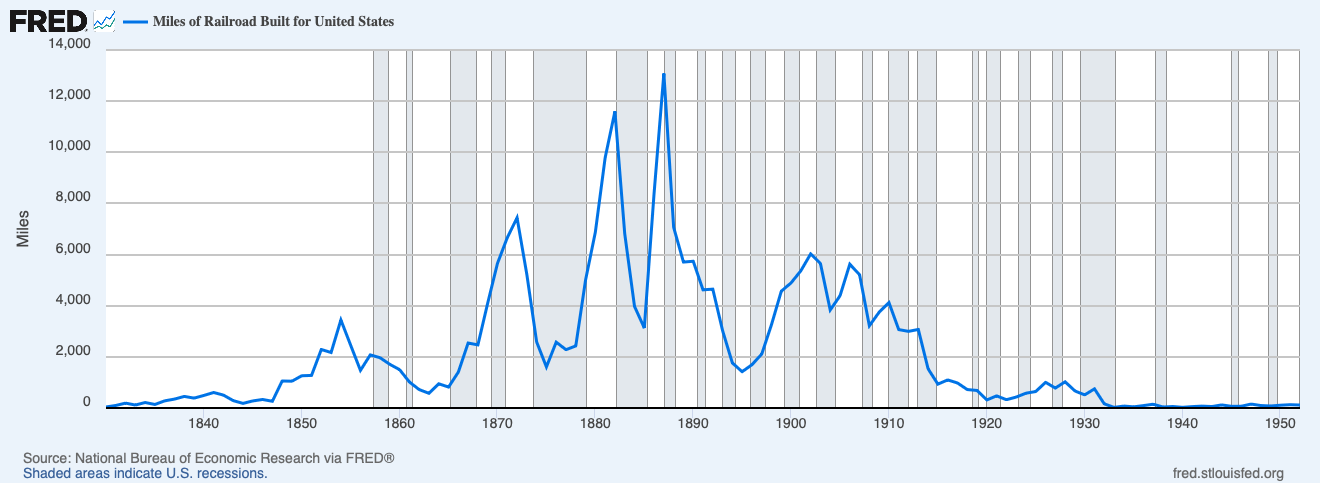
Source: Federal Reserve Bank of St. Louis
If you look at the total miles of track in the country each year, it’s easy to see the rise and fall of the railroads. The United States peaked in 1916 with approximately 254,000 miles of track, before declining to roughly half, 137,000 miles today.
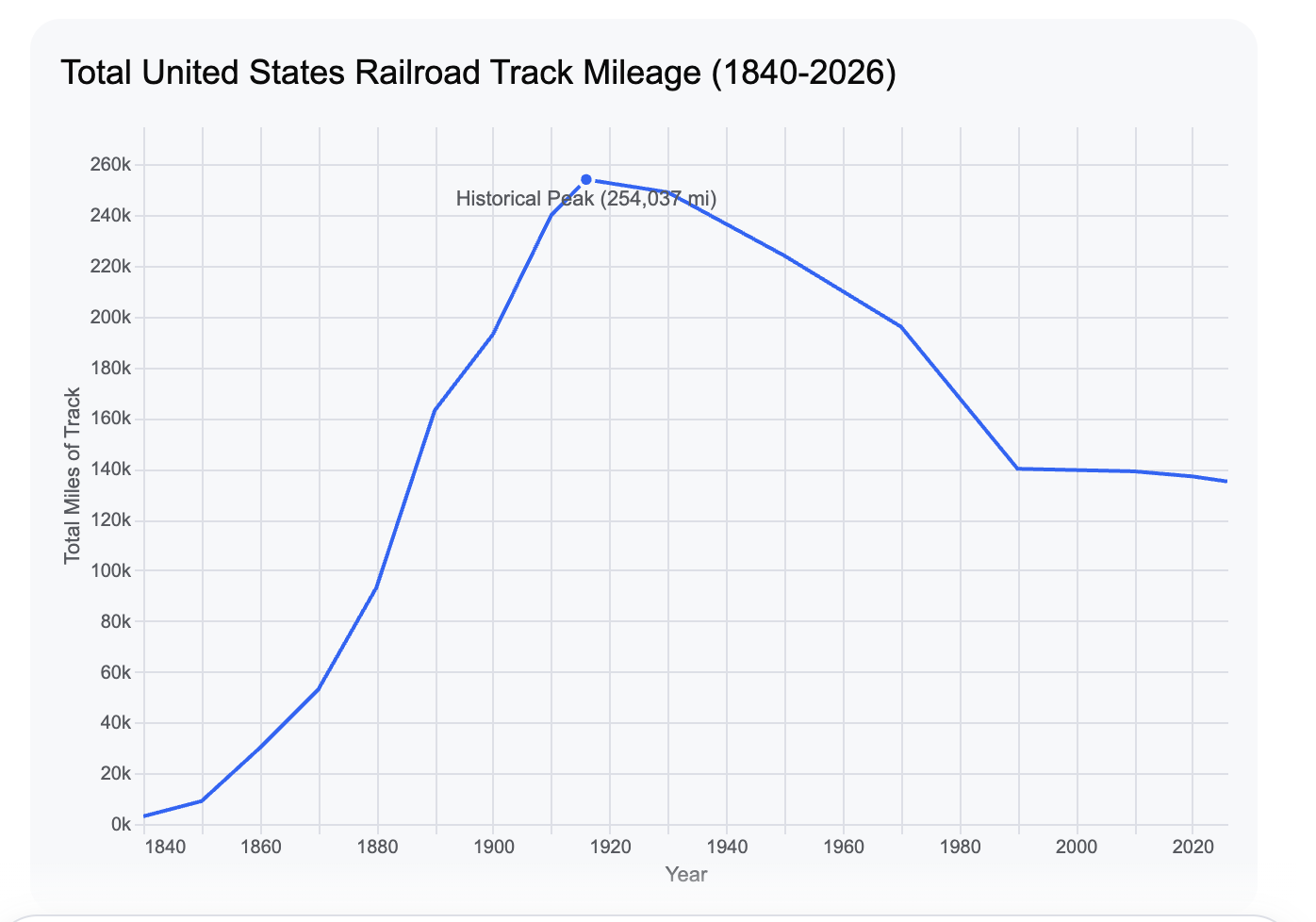
The peak in railroad mileage, in 1916, was right around World War I and the Spanish Flu epidemic, two events that shook the world economy. The peak also roughly corresponded with the emergence of the next big transportation breakthrough, gasoline powered automobiles and trucks, and the development of a national highway system.
Tracks and infrastructure
The first hurdle for the early railroad companies was to get enough financing to lay tracks and build other infrastructure, like cars and depots and switching yards and repair shops. Railroad founders made assumptions about how much money they would need to build the railroad infrastructure, and about how much they would be able to generate later from operations. They generally grossly underestimated the cost to build the infrastructure and grossly overestimated how profitable their operations would later be.
Some of the hundreds of companies that were created failed without building anything because they couldn’t get funded. Other companies laid some track but then ran out of money faster than they anticipated in their overly rosy cost estimates and went out of business.
In spite of the cost and the problems, hundreds of miles of track were built. Too much, all at once, and not necessarily in the right places. The railroads built infrastructure suitable for many times the traffic they would ever actually realize.
Operations
Things didn’t get better if a railroad successfully laid track and started operations. They were burdened with debt from building the tracks, and had to repay it, along with interest. It would have been challenging to be profitable under the best circumstances.
Railroads were often built into areas that were nearly uninhabited before the railroad reached them. Eventually many of the towns and cities on those routes were populated, but it took time. The rosy assumptions were of traffic that was much further in the future than many railroad companies assumed.
The rosy assumptions also did not take into account the impact of the explosion of competition from other railroads. As more and more tracks were built, whatever traffic there was was divided into smaller and smaller slices. Eventually cut-throat competition resulted in brutal rate wars.
When the traffic, or the rates, or both, were less than projected, the railroad often ended up going out of business.
The government, which helped many railroads get started, may have contributed to their operational failures as well. Governments regulated rates, requiring railroads to operate even if the rates were less than the cost of providing services. Government regulations prohibited railroads from abandoning tracks that weren’t where they needed them. Government regulations required railroads to provide passenger services even where passenger service wasn’t profitable. Many champions of the railroads point out that governments funded the railroads’ biggest competition, the highway system, while restricting railroads from taking many steps that would have helped them to adapt to the competition.
Fraud and deception
Poor planning and inadequate funding weren’t the only problems. There was also self-dealing and fraud.
Companies who were able to raise cash by selling stock didn’t stop at selling the original stock that was issued. If there was a market for it, they just kept issuing more and more stock. That meant that earlier buyers ended up owning less and less, since whatever value there was in the company was spread across more and more owners. Eventually their investments were worth far less than they had originally paid for them. For example, Cornelius Vanderbilt tried to buy up the stock of the Erie Railroad. The owners weren’t having that. For every share he bought they issued new convertible bonds, then immediately converted them to stock, eventually issuing 200% in new shares. Vanderbilt spent millions buying railroad stock without getting control.
A common practice was for the owners of a railroad company to create a completely separate service company, then contract with their own company to do the work. The most dramatic example of this was the Union Pacific. Union Pacific was created by congress to construct and operate the eastern half of the transcontinental railroad. The owners of the Union Pacific created their own construction company, called Crédit Mobilier of America. Union Pacific hired Crédit Mobilier to do the actual work, and funneled all their receipts to it. Crédit Mobilier then found ways to do the work for half the cost. The private company generated profits of about 100% on the work they did, a nice deal for Crédit Mobilier that did nothing for the stockholders of Union Pacific. No good deal goes undiscovered forever. Several congressmen found out about the scam, but instead of putting a stop to it, they dealt themselves in by taking bribes. Newspapers finally broke the story in 1872 and it was a national disgrace that contributed to the first big railroad bust in 1873. Eight members of Congress and the Vice President of the United States were implicated and the Union Pacific went into bankruptcy for the first time. It would go bankrupt again later, but eventually was reorganized and emerged as one of the only companies that survives today.
Booms and busts
The boom/bust cycles repeated several times. Hundreds of companies were created. They built tracks and went out of business before they ever got into operation, or they began operations but couldn’t make money. In the busts, hundreds of companies went out of business.
In the following boom, new operators sucked up the bankrupt companies and their tracks and infrastructure for pennies on the dollar, and started building again. Then the reorganized companies, too, ran out of money and went out of business.
Hundreds of railroad companies were created, and a huge percentage eventually went out of business. After years of bankruptcies and reorganizations and mergers, today there are just six major railroad companies, four in the USA and two in Canada. Two of the six have proposed a further consolidation (the Union Pacific wants to acquire Norfolk Southern), and there is no telling if that will go through.
Some of the consolidations consisted of one company acquiring the tracks and infrastructure of another, some were outright bankruptcies where track was abandoned, and some were consolidations where the surviving company kept some tracks and abandoned others.
Since the peak in railroad track mileage, about half of all the original track has been abandoned, eliminating 120,000 miles or so of all the track laid in the boom years. Millions of dollars were spent to lay all that track. The cost of all those abandoned tracks is impossible to estimate.
Bankruptcies and reorganizations
After the early booms and busts in the 1870s, 1880s, and 1890s, the patterns of bankruptcies and reorganizations continued. The low point for the industry was the early 1970s. After waves of bankruptcies, including the bankruptcy of six major railroads in the Northeast, including the Penn Central Railroad, Congress acted to avoid the complete collapse of major supply lines in the country.
Congress created Conrail (Consolidated Rail Corporation). Conrail was a government-funded private entity to consolidate failing operators, trim unprofitable lines, and rebuild a viable rail network. In 1980 Congress passed the Staggers Act which deregulated the railroad industry. Railroads were then able to abandon unprofitable services and lines and set their own rates.
By 1986, Conrail was profitable, and its stock was sold to the public. In 1996 Norfolk Southern Corporation and CSX Corporation acquired Conrail and divided its assets between them.
The six surviving major railroad freight companies are:
Union Pacific
Norfolk Southern
CSX
BNSF
Canadian National
Canadian Pacific
One of the reasons railroads struggled to survive was that passenger traffic was not profitable, but railroads were required to provide passenger service. Losses from passenger service were part of the reason for all the railroad bankruptcies in the Northeast. In 1970, President Nixon signed the Rail Passenger Service Act which created another government entity, Amtrak, to take over passenger service. Amtrak did not get ownership of any tracks. It uses the tracks that are owned by the freight railroads. That contributes to at least some of the problems it has providing on-time service, since Amtrak cars can be delayed by freight cars. Many people assumed Amtrak would quickly lose money and be eliminated, but it has survived. There is a great difference of opinion about whether Amtrak should continue to exist, whether it ought to be government owned, whether it ought to be profitable, or if it should be considered a public service that keeps at least some traffic off the roads and out of the skies.
Another notable thing that happened during this tumultuous period was the national Rails to Trails project. Rails to Trails has turned abandoned railroad tracks and right of ways into 42,000 miles of public trails. President Reagan signed an act in 1983 creating Railbanking. Railbanking preserves the railroad right of way in case those right of ways are needed in the future, while allowing them to be used as trails in the meantime. That preserves the potential of recreating some of what has been lost.
Lessons for today
What does the history of railroads tell us about the future of AI? That was a different revolution and a different time, but I do think there are some lessons. If we lived in the 1800s and were trying to predict what would happen, what would we have gotten wrong, and right?
AI is formidable because it looks like it can and will completely reshape almost everything. That’s why we can’t just ignore it and hope life will go on as always. Railroads did that too, in their own way. Without railroads the western half of the country would not have gotten populated until much later, and completely different parts of the country likely would have taken off. Railroads made it economical for huge farms in the middle of the country to survive and get their crops to market. Trucks eventually would be able to carry heavy loads, but not at the scale required for the current scale of agribusiness. Railroads connected the far west to the east. Highways and airlines would do that too, but not until much later.
Railroads led to all kinds of other innovations that shape our world today, the modern stock exchange, and related standardized rules for accounting, along with public bond markets. Investors needed information about the things they were investing in. They wanted annual reports and financial information. And railroads operated in far-flung locations, requiring them to standardize methods of controlling cash and managing operations. So the railroad industry also led to modern systems of accounting and financial controls.
Telegraph lines used the railroad right of ways and never could have crossed the county without them. Telegraph technology later led to telephone and other modern communications breakthroughs. The list of ways that railroads changed the country goes on and on. Even though the railroad industry is much smaller than it used to be, it has left a huge mark.
Anyone who thought that railroads would change the world was completely right about that. Anyone who thinks AI will change the world is completely right about that too.
If you were an investor in the mid 1800s who thought that railroads would change the world, you might have decided to buy stock in a railroad company. That would have been a huge mistake. None of the early companies survived intact, any early investors would have been wiped out when the railroad went bankrupt. You might have tried to buy railroad bonds instead of stock, but you still would have been wiped out. You might have tried to buy land where the railroads were laying track. If you bought land in busy corridors where the railroad survived, that would have worked out well. If you bought land where the tracks were later abandoned, maybe not so much.
The country spent millions of dollars building tracks, and ended up building too many and in the wrong places. AI is generating millions of dollars of investment in data centers, perhaps too many, perhaps in the wrong places.
Railroads assumed they’d be able to operate their businesses as though there was no competition. Competition made it far more difficult to be profitable, it led to rate wars that took some railroads out of business. AI is already starting to see rate wars from increased competition. Whatever they thought they could earn from operations could be at risk.
Railroads assumed that as soon as they built tracks, traffic would materialize. It didn’t. It took years, and in some cases there never was the traffic they expected. We don’t yet know what traffic will be for AI. We know there’s traffic when AI is free, but it’s more questionable how much traffic there will be now that providers are charging for it.
Government regulation made it much harder for railroads to operate. There will certainly be more and more government regulation around AI.
There was self-dealing and fraud in the railroad boom, making it hard to evaluate the true condition of investments and operations. Nobody has accused anyone in the AI industry with fraud, but there is at least obscurity in millions of dollars of contracts between AI companies, where one company books a loan and another books revenue. If any of these companies goes out of business it will ripple through all of them.
Railroads were a paradigm change. Making predictions is hard in any case, but it’s especially hard when the paradigms are changing. Early train routes were designed to get freight to the nearest waterway, and to connect waterways. Nobody yet had gotten their heads around the potential for something completely new. Similarly, AI is a paradigm change. When paradigms change, nobody knows what will happen.
For example, all the discussion about AI destroying jobs assumes that AI will be used primarily to do things that humans do now, and if AI does it humans won’t have anything else to do. But what if the future is that AI is instead focused on doing things we can’t even imagine doing now. Since we know there are going to be limitations on finding enough compute and power and equipment to run AI, wouldn’t it make sense to focus those resources only on things humans can’t do now? In that future, there would still be plenty for humans to do. That’s a rosy prediction, but hopefully the point is clear. We just don’t know.