
My granddaughter came to visit last week, riding the train down from Chicago where she was visiting friends. That got me thinking about railroads, and how transformative railroads were in the 1800s. Maybe just as transformative then as AI looks to be today.
Many people compare the AI bubble to the dot com bubble of 2000 or the housing bubble of 2008, but I think it might be more like the railroad bubble of the late 1800s. Nobody alive today remembers that bubble, and it’s easier to compare AI to things more people are familiar with, but the railroad bubble may be a better analogy.
The Relevance of Railroads
It’s easy to understate how revolutionary railroads were, we’ve come so far past the 1800s world that railroads transformed. But consider:
Before railroads, heavy cargo like wood and grain and iron ore and fuel could only be moved short distances, perhaps using rivers that only flow one direction and might be covered in ice in the winter. Railroads could easily carry those heavy loads any distance, any direction, in any weather.
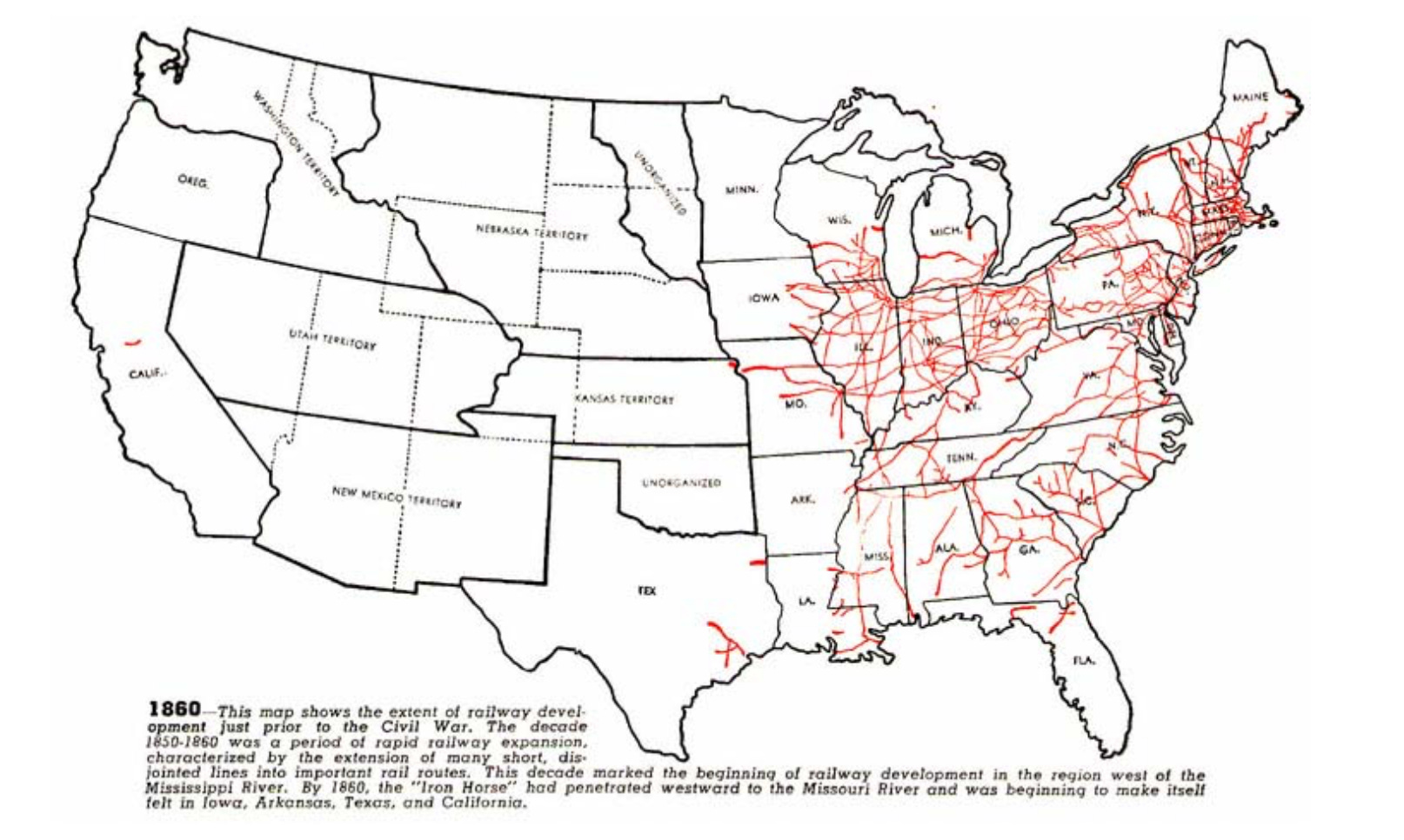
Before railroads, anyone trying to move to the western half of the country got there by boat, wagon, horseback, and foot in journeys that took weeks or months. By the end of the 1800s a person could go coast to coast on the railroad in six days.
Most major cities in the western half of the country owe much of their existence to the railroads. Railroad development created cities as the railroads expanded west, and the same railroads brought people to live in those cities, along with the supplies they needed to build houses and stores and businesses. The Homesteading Act of 1862 said anyone could become a land owner, and the railroads made it possible. My mother’s grandfather and his family fled Russia in the late 1800s, sailed into New York City, then took the railroad to the end of the line in South Dakota to become homesteaders. There must have been millions like them.
Before development of the railroads, about 5% of the population of the country lived west of the Mississippi River. By the end of the 1800s, 25-30% lived west of the Mississippi River. That’s pretty transformational, and it could not have happened without the railroads.
The investment made in railroads was huge. We don’t yet know what the total investment in AI will be in the end, but for comparison:
Total investment in AI to date: ~1-2% of US GDP
Total investment in telecom in 2000: ~1% of US GDP
Total investment in housing in 2008: ~6% of US GDP
Total investment in railroads in 1800s: ~6% of US GDP
Railroad companies also represented huge percentages of the total stock market, for comparison:
AI company market cap today: ~40-48% of total stock market
Telecom market cap in 2000: ~41-44% of total stock market
Housing market cap in 2008: N/A exactly, it was a real estate bubble, not a stock market bubble
Railroad market cap in 1800s: ~63% of total stock market
I look at history to try to understand where current events are taking us. “History never repeats itself, but it often rhymes” is a quote usually attributed to Mark Twain. You can’t expect everything to end the same way it did before, history never repeats exactly, but you can glean hints of how today’s events will play out by looking at similar things that went before.
As you can see, the railroad bubble was huge both in terms of total investment and in its dominance of the stock market. It is certainly big enough to qualify as a potential “rhyme” for AI.
The History of Railroads
Like most transformative technology, railroads of the 1800s built on a number of revolutionary developments that came together to create something revolutionary. There are several elements that came together in the mid 1800s to ignite the revolution.
Tracks
One important component of a railroad is that it runs on tracks. In the 1500s and 1600s Europeans used tracks with wooden rails used to pull cargo more easily. Power for those early systems was supplied by animals or humans.
In the 1750s, builders began using cast iron to cover the rails. The cast iron was brittle and eventually replaced by wrought iron in the early 1800s. By the mid 1800s processes for developing steel were improved to make steel cheaper to produce and much more durable. Wrought iron rails were replaced by steel rails.
Over the same period, the design of the rails and the wheels was modified, adding flanges to the wheels and adding and then removing edges on the sides of the rails. All of these modifications were designed to find the best way to keep the wheels on the rails and reduce friction. Eventually almost everyone ended up with the current design, wheels that have flanges running on smooth rails.
All these improvements in wheel and track material and design culminated in the mid to late 1800s, the time of the railroad bubble.
Power
The earliest “trains” used human or animal power to pull cargo. There were obvious limits to how much weight they could pull, and the source of energy was all or mostly external to the vehicle being pulled. A team of oxen walking on the bank might pull a ship through a canal, for instance. What was needed was an engine that was powerful enough to carry the cargo while being mounted on the vehicle itself.
The revolution here was the invention of the steam engine. Steam engines were extremely powerful. Steam engines were also huge, so the first job was to make them portable, but still powerful enough to pull their own weight along with the extra weight of a cargo. Steam locomotives were first developed in the early 1800s, and they completely revolutionized railroads. With a steam locomotive, a train could do something crazy, like power itself all the way across the country!
About the same time as the steam locomotive was being developed, there was also work going on to create electric train engines. Electricity didn’t make much sense for long distance trains, but was perfect for intra-urban uses, like subways.
Later, in the early 1900s, diesel became the fuel of choice for long distance trains, but that was a later development.
Proof of Concept
The Civil War took place in the mid 1800s. In the South, there were not a lot of railroads. They were mostly small railroads designed to send products to nearby ports for shipping. In the North railroads were much more expansive, and some were designed to go east to west or north to south, not just to get to the nearest port. The brutal Civil War ended up being a demonstration case for the value of having the ability to move people and supplies quickly and easily around the country. There are a number of experts who think that the better railroad system in the North was an important factor in the North’s victory.
Source: Central Pacific Railway Photographic History Museum
Land
Once you have a train that could potentially cross the country, and you have a proof of concept that shows the value of railroads, you need one last, really important asset. You need land to build the tracks on. If the train is going to go very far, you need a lot of land. That land might be prohibitively expensive.
A big turning point in railroad land expansion dates to 1862, during the Civil War. The Union wanted to make sure California didn’t succeed from the Union, so they promised to get a transcontinental railroad built, in order to link California to the eastern part of the country.
In 1803, the government bought 828,000 square miles of land from France. By 1862, it was mostly undeveloped, and the few developed places on the west coast were completely separated from the rest of the country. The government couldn’t build a railroad, and they didn’t have cash, but they had a huge amount of land. It seemed to be in everyone’s best interest to use what the government had, land, to get what was needed, a coast to coast transportation system.
To do this, the government decided to make land grants to the railroad companies. It was an interesting solution. They did not give all the land, outright, to the railroads. They created a checkerboard. Every other section was granted to the railroad, with the alternating section retained by the government. Theoretically, the development of the railroad would increase the value of all the land. The government would be repaid by the increase in land value, while the railroads would be incentivized to get the railroads built.
The railroads then built on some of the granted land and sold the rest of it, providing a lot of the money they needed to build the railroads. They got good prices for the land they sold, since it was land right next to the new railroad.
The Bubble
That’s the background, why the railroads were such a huge revolution and why they were so important. In my next post I’ll talk about the bubble. Or the bubbles, I should say. There was a bubble and a bust and another bubble and another bust.